Configuring Card Reader/Machine Vend Prices
In most cases, vend pricing is set through the Laundroworks system using the Laundro Portal.
But in some cases, it is the laundry machine that controls the vend pricing directly.
The following is a list of machines where vend pricing comes directly from the machine itself, and is NOT set through the Laundroworks system:
- Dexter X-Series Washer and Dryers, and Dexter C-Series Dryers
- Alliance (Speed-Queen) Quantum/Midas Touch Washers and Dryers
- Maytag Gen2 control Washers and Dryers
- LG Washers and Dryers
- All Vending Machines, including VendRite
If you need to configure prices for the above machines, you'll need to do that directly through the machine's interface.
Once the price is set on the machine, the machine will automatically instruct the Laundroworks card reader as to what price to display, and charge, to the Laundry Cards/LaundryCat app accounts.
For the above machines, it is still recommended that you put all Card Readers into custom Machine Groups, for reporting purposes.
All vend price settings are handled on the machine directly so you'll want to consult the manual for your specific machine, or reach out to your distributor, to get instructions on adjusting the machine specific settings that control vend pricing.
For all other types of machines, read below.
Prerequisites
Before you can begin setting prices, you first need to ensure that:
- The Value Add Center (VAC) is online (if there are multiple VACs, ensure that VAC01 is online as this is the primary VAC that communicates with all card readers in the location).
To confirm VAC01 is online, log onto the Portal, click on your location address, and confirm that you see VAC01 and that it is NOT indicating a status of Offline:
If VAC01 is currently offline, you will need to get VAC01 online before you can configure any card reader settings.
Review our VAC Offline and Internet Issues article for troubleshooting steps for a VAC Offline issue - The card readers, that you wish to set the prices, of are Activated (using the Activation card for this specific store location),
The card readers must be visible online on the Laundro Portal, and their status should NOT be indicating an error (like Machine/Serial Communication):
The screenshot below show's VAC01, and all readers, are online and ready to be priced:
Manage Groups Menu - Creating Custom Machine Groups
Before setting any prices, it is strongly recommended that you first create Machine Groups, and add the readers representing those machines, to these custom Machine Groups.
This will allow you to apply price changes, to all the readers in the same group, using one operation (another benefit of grouping is that this will allow you to run reports on machines, based on these custom machine groupings)
If you already have your machines grouped into custom machine groups, move on to the next section of this article.

Note that custom machine groups are only for Washer and Dryer Card Readers.
Door, POS, and Vending machines readers cannot be placed into custom groups
Door, POS, and Vending machines readers cannot be placed into custom groups
To group all of your Washer/Dryer Card Readers into custom machine groups
click the Manage Groups button in the top right corner of the Machines table header:
Inside the Machine Group Management page,
Click the "+ Add New Group" button to create a custom machine group:
Give the group a meaningful name, such as "18lb washers"
then click the Save button to create this new group:
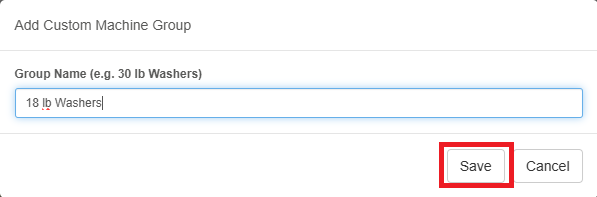
Navigate to the newly created group, and use the dropdown menu to select a reader number that is installed on any machine that belongs in this group
Then click "+ Place Into this Group" button to add that specific reader into this group:
Continue selecting all other readers that belong in this group (you'll do this 1 reader at a time, pressing the "+ Place Into this Group" after each reader you add)
until all of your 18lb washer readers are listed in the group.
Then continue by making additional custom groups, for all of your different types/sizes of machines, including Dryers.
Note: unable to add a specific reader into a group it belongs in?
When adding readers into a specific machine group, you are only able to add readers, that use the exact same reader settings.
If you have machines that are not all of the same model type, it is probable the reader settings are not exactly the same, between the different model machines.
In cases like these, if you have 2 different types of 45lb Washers for example, you will need to make separate custom groups for each type of 45lb Washer model you have.
(for example, you cannot put a 45lb Dexter Washer in the same group as a 45lb Alliance Washer)
If the system is not allowing you to add a specific reader to a group, it is most likely because that reader is installed on a different model of machine; so you will need to create a separate custom group for the different model machines
Card Reader Price Settings - Communication Types
When it comes to setting Card Reader pricing, all card readers operate in a similar manner, based on their communication type.
There are 2 Card Reader communication types that affect how pricing will work:
1) Serial Communication (2-way direct communication between the Card Reader and Machine's control board)
Serial Communication allows the card reader to always be in sync with the machine. Pricing only needs to be updated on 1 side (either on the machine side, or on the card reader side, depending on the specific machine).Serial communication allows the card reader to know what cycle options are being selected, so multiple vend price levels can be set for different cycle options.
2) Pulse Communication (coin drop emulation - no direct communication with machine's control board)
Pulse Communication means the card readers are simply emulating a "coin" being inserted into the machine, whenever a Laundry Card/LaundryCat app account is tapped to the card reader. In most cases, the reader will insert 1 "coin" into the machine to trigger payment.With pulse communication, the pricing will need to be set on both the card reader side (so the reader knows how much to charge Laundry Cards/LaundryCat app accounts), AND the machine side (so the machine displays the same price the card reader is charging.Pulse communication only allows for 1 vend price to be configured, as the card reader has no way of knowing what cycle option is being selected at the time of payment.
Serial Card Reader Price Settings - By Machine Manufacturer
Alliance Machines (SpeedQueen/Huebsch)
Depending on the specific model, your card readers will be using either Serial or Pulse communication.
Serial Communication - Card Reader Controls Vend Pricing:
Below is an example of the type of card reader vend price settings you may see when the Card Reader is in control of machine pricing:
Alliance Washers will usually report the name of the base cycle option being priced, these include base options like Normal, Perm, and Delicate.
The Extra Options (Modifier 2 and Modifier 3) are modifiers that are added to the price of the selected base cycle.
If you see Modifier 1 (set to $0), it is best to ALWAYS leave this Modifier set at $0. If this modifier is anything other than $0, it will ADD $$ to ALL cycle options (so if Modifier 1 is set to $0.75, then all cycle option prices will be increased by $0.75.
Common uses for Modifier 2 and Modifier 3 settings are things like Extra Wash and Extra Rinse options; or to control what happens when the Light, Medium, or Heavy cycle option buttons are used.
When the machine does not report a specific Modifier by name, you'll just see the label "Extra Option (Modifier 2)", "Extra Option (Modifier 3)", etc.. In these cases it's best to use 1 machine as a tester, price each modifier with a different price, and select the different Modifiers on the machine to find out which Modifier # corresponded to a specific cycle modifier.
Below are a few examples of what these modifiers can control:
Alliance Dryers will usually report the different temperature options, as well as settings to adjust the price AND time for adding top off time to an already running machine.
It is important to note that the amount of Dry Time these Dryers starts with, is completely controller by settings on the machine directly (you cannot affect the starting dry time from the Laundro Portal)
However, it IS possible to adjust how much Top Off time the dryers add, by adjusting the Card Reader's "Topoff Time (min)" setting.
If you setup a full cycle/top off time pricing model; then your full cycle temperature pricing (High Temp, Medium Temp, Low Temp, etc.) would be a different price than the machine's Topoff Price setting. In cases where the Top-Off price is different from the Full Cycle/Starting price, when customers are adding additional top off time, they will be required to hit the machine's Start button each time they want to add additional time (Laundry Card must be present on the reader when the machine's Start button is pushed).
If the full cycle cost (for all temperature options), and top off cost are the exact same; then customers will only need to push the machine's Start button when starting the machine from idle. Once the machine is running a cycle, simply tapping a laundry card to the Card Reader will add the additional top off (the Start button does NOT need to be pushed at all when adding top off time)
If the full cycle cost (for all temperature options), and top off cost are the exact same; then customers will only need to push the machine's Start button when starting the machine from idle. Once the machine is running a cycle, simply tapping a laundry card to the Card Reader will add the additional top off (the Start button does NOT need to be pushed at all when adding top off time)
Serial Communication - Machine Controls Vend Pricing:
Below is an example of what you will see if your serial communication card reader does NOT control the machine's vend pricing (there will be no vend price settings listed at all):
You will also notice that if you navigate to the Bulk Pricing Menu, you will see a note for the Dryers that there are no price settings to configure, and for the Washer readers, you will only see a setting for configuring the Free Dry Bonus Amount:
These are all indications that the Laundro Portal is NOT used at all to set machine prices.
Prices need to be updated on the machine directly, and the machine will update the card reader with the new price
Pulse Communication (Card Reader and Machine pricing is set separately):
See the section below that discusses Pulse Communication Card Reader Pricing
Dexter
Depending on the specific model of Dexter machine, your card readers will be using either Serial or Pulse communication.
Serial Communication - Card Reader Controls Vend Pricing:
This is only possible on Dexter C Series machines, running updated reader firmware.
Below is an example of the card reader vend price settings you will see when the Card Reader is in control of machine pricing:
Only the price settings in the Green Box are used for adjusting reader/machine pricing.
Dexter machines will report the name of the base cycle option being priced (Hot, Warm, Cold) as well as the name of the cycle modifiers (Extended Wash, PreWash, Extra Rinse, Super Wash). The Modifiers will ADD to the base cycle costs.
You will always be able to set a price for all of these modifiers, even if the specific modifier is NOT enabled on the machine itself.
If the modifier is not enabled on the machine side, customers will be unable to select that modifier option (even if the card reader shows a price for it).
Serial Communication - Machine Controls Vend Pricing:
Dexter C Series Dryers, and Dexter X Series Washers and Dryers do not allow for the Card Reader to control pricing.
Below is an example of what you will see if your serial communication card reader does NOT control the machine's vend price (there will be no vend price settings listed at all):
You will also notice that if you navigate to the Bulk Pricing Menu, you will see a note for the Dryers that there are no price settings to configure, and for the Washer readers, you will only see a setting for configuring their Free Dry Bonus Amount:
These are all indications that the Laundro Portal is NOT used at all to set machine prices.
Prices need to be updated on the machine directly, and the machine will update the card reader with the new price
Pulse Communication (Card Reader and Machine pricing is set separately):
See the section below that discusses Pulse Communication Card Reader Pricing for general information on setting prices for a pulse communication card reader.
One eliment that is specific to select Dexter pulse machines (e.g. Dexter A Series washers), is an additional Super Cycle option which can be enabled on the machine side.
If enabled, this option allows the machine to prompt for an additional payment after it's initial wash cycle has started (the prompt is usually only seen in the first 1 to 2 minutes of the initial wash cycle being started). This additional payment will upgrade the base wash cycle to extend it's wash/rinse times.
On Dexter pulse readers, you will see Supercycle settings that can be used to price this additional cycle option:
If your machine does not have this supercycle option, or you've disabled supercycle on the machine side, these settings should be left at 0.
If supercycle is enabled on the machine side, you'll use the supercycle reader settings to set the cost of this cycle upgrade (this will be charged in addition to the base cycle price), and the supercycle time should be set to the amount of time this cycle upgrade adds to the base cycle time.
Wascomat / Electrolux / Clarus Vibe / Compass Pro
Depending on the specific model, your card readers will be using either Serial or Pulse communication.
Serial Communication - Card Reader Controls Vend Pricing:
Below is an example of the Card Reader vend price settings you will see when the Card Reader is in control of machine pricing:
In most cases, these machines do NOT report the name of the base cycle option being priced, as some of these machines allow you to create/remove custom base cycle options. On these machines, the card reader can only report the Program# for the different possible cycle options.
You may see up to 12 different base programs# listed on the Laundro Portal, however this does NOT necessarily mean that your machine has 12 different cycle options in use.
If your machine only has 6 different cycle options currently programmed on the machine side, then only 6 of the Laundro Portal Program#s will actually correspond to prices on the machine.
To figure out which Program#s corresponds to a specific cycle option on the machine, it's best to set each Program# to a different price (Program1 = $1, Program2 = $2, Program3 = $3, etc.) and then test a machine to figure out which Program# corresponds to a specific cycle option. You can then program all machine cycle options based on that information.
Note: it is possible that not all machines are running the exact same programs, in the exact same order.
So if you find a few machines that seem like they're pricing cycle options incorrectly; it's likely those machines either have extra or less programs than the other machines, or their cycle options are listed in a different order.
The different cycle option modifiers/add-ons will usually be listed by name. These options ADD to the base cycle that's selected.
You will see pricing for all possible cycle modifiers/add-ons, even if the modifiers are not actually enabled on the machine.
There is no harm in pricing a program/add-on, that's not currently being used by the machine.
It is sometimes recommend to set a price for the unused Program#, that way if you add a program in the future, it will already be priced as opposed to being initially setup as a $0 cycle option.
Pulse Communication (Card Reader and Machine pricing is set separately):
See the section below that discusses Pulse Communication Card Reader Pricing
Maytag/LG
Depending on the specific model, your card readers will be using either Serial or Pulse communication.
Serial Communication - Machine and Card Reader control different payment methods:
For these machines, Serial Communication dictates that the Machine will controls all Vend Pricing related to Laundry Card payments; but the Card Reader will control Vend Pricing related to the LaundryCat app payments specifically.
If your store does NOT make use of the LaundryCat app, then you can ignore all vend price settings listed for the Card Reader on the Laundro Portal.
The machine is in control of all vend pricing; once the price is updated on the machine side, the machine will update the card reader with the correct price.
If your does IS using the LaundryCat app, then you will need to set the vend price on both the machine side, and on the Laundro Portal for the Card Reader.
The machine controls the price that Laundry Card paying customers are charged, but for customer's using the LaundryCat app, you'll set the price of the Card Reader so it charges LaundryCat app accounts correctly.
Below is an example of the card reader vend price settings you will see for Maytag/LG Serial Communication Card Readers:
As stated above, if your store does NOT use the LaundryCat app, there is no need to update the Card Reader's Mobile Only/Mobile Prepayment settings, since they will not be used at all.
For locations that use the LaundryCat app, these settings are used so the card reader charges the correct amount to the app during the first tap of a phone.
If you have multiple vend prices, for different cycle options; then this setting should be set to the cheapest base cycle price.
The app will be debited the base cycle price during the first tap, and if the customer has selected a more expensive cycle option, the reader will prompt them to tap their phone again to pay for the extra value needed to cover the more expensive cycle option that was selected.
Pulse Communication (Card Reader and Machine pricing is set separately):
See the section below that discusses Pulse Communication Card Reader Pricing
Fagor/Domus
Fagor/Domus Washers will typically use Serial communication (with the exception of Hybrid Coin+Card configurations), while all Dryers will use Pulse communication.
Serial Communication - Card Reader Controls Vend Pricing:
Below is an example of the card reader vend price settings you will see when the Card Reader is in control of machine pricing:
In most cases, these machines do NOT report the name of the base cycle option being priced, as some of these machines allow you to create/remove custom base cycle options. On these machines, the card reader can only report the Program# for the different possible cycle options.
You may see up to 12 different base programs# listed on the Laundro Portal, however this does NOT necessarily mean that your machine has 12 different cycle options in use.
If your machine only has 4 different cycle options currently programmed on the machine side, then only 4 of the Laundro Portal Program#s will actually correspond to prices on the machine.
To figure out which Program#s corresponds to a specific cycle option on the machine, it's best to set each Program# to a different price (Program1 = $1, Program2 = $2, Program3 = $3, etc.) and then test a machine to figure out which Program# corresponds to a specific cycle option, and then program all machines based on that information.
There is no harm in pricing a program/add-on, that's not currently being used by the machine.
Note: it is possible that not all machines are running the exact same programs, in the exact same order.
So if you find a few machines that seem like they're pricing cycle options incorrectly; it's likely those machines either have extra or less programs than the other machines, or their cycle options are listed in a different order.
It is sometimes recommend to set a price for the unused Program#s, that way if you add a program in the future, it will already be priced as opposed to being initially setup as a $0 cycle option.

Fagor/Domus Washers can be sensitive to price adjustments done while the machine is currently running an active cycle.
It is recommended to only adjust reader settings on Washers that are at idle.
If you adjust a reader price setting, and get an error message on the machine's display, you can usually correct this error by resetting the machine
If you adjust a reader price setting, and get an error message on the machine's display, you can usually correct this error by resetting the machine
Pulse Communication (Card Reader and Machine pricing is set separately):
See the section below that discusses Pulse Communication Card Reader Pricing
Other (IPSO, ADC, Continental-Girbau, Milnor, Hero, Encore, etc.)
With most other machine manufacturers our Card Readers will typically use Pulse communication as oppose to Serial Communication (however there are a few exceptions, e.g. Hero Washers, and Continental-Girbau: (Genius) Washers usually use Serial Communication Card Readers).
Serial Communication - Card Reader Controls Vend Pricing:
You will be able to tell if your specific Card Reader is using Serial Communication,
by checking the Card Reader's Control Type setting, to see if it says "Serial" somewhere in the Control Type name:
If the Control Type being used has the word "Serial" in it, then the reader is in direct communication with the machines control board.
If you see price settings available in the reader settings, it means you can adjust the prices of these machines from the Laundro Portal directly, and the card reader will update the machine to display the new prices automatically.
Note: the different pricing options you will see will be dependent on the type of machine a Serial Communication Card Reader is connected to.
The Card Reader will show you all available pricing options, based on the information it's getting from the machine's control board directly.
The Card Reader will show you all available pricing options, based on the information it's getting from the machine's control board directly.
If you see "Serial" in the name, but there are no vend price settings to configure, then the machine is in control of the prices.
For these reader's, once pricing is updated on the machine directly, the machine will automatically update the card reader with the new prices.
Pulse Communication (Card Reader and Machine pricing is set separately):
See the section below that discusses Pulse Communication Card Reader Pricing
Pulse Communication Card Reader Price Settings
Below are a few examples of the card reader settings you will see if your card reader is using some form of Pulse communication:
You will only have 1 vend pricing option, and 1 time setting option (an exception, like on Dexter A Series machines, which will have extra Supercycle settings, which is an extra payment that can be made 1-2 mins after the machine's cycle has been started)
The Price/Cost setting dictates how much customer Laundry Cards/LaundryCat app accounts are charged to start a Washers/add time to a Dryer
The Time Unit (mins) settings is for you to inform the card reader how long a wash cycle is, or how much dry time customers get, when paying for that specific machine.
The "Time Units (mins)" setting DOES NOT control how much time a Washer/Dryer cycle lasts for.
This is for simulation purposes, so the card reader knows approximately how long a wash/dry cycle lasts for. This allows the Card Reader to stay in sync with what's happening on the actual machine.
When adjusting vend prices on Pulse communication machines, you need to adjust the reader settings (so the reader charges the correct amount), and then separately adjust the machine side settings (so the machine displays the correct amount).
In most cases, the machine is only getting 1 "coin" inserted into it, whenever a Laundry Card/LaundryCat app account is used to make a payment.
This means, that when adjusting the machine's vend price, you want to ensure that the machine's Coin Value setting is also adjusted to equal the new vend price.
Since the card reader is only inserting 1 "coin" into the machine, the machine needs to know that the 1 "coin" it's getting from the card reader, is worth the full price of the machine. Otherwise, it would take multiple card payments to satisfies the machine's new vend price and start the machine's cycle.
In some rarer cases, especially if you have a Hybrid Coin+Card setup, you're Pulse communication card reader may be showing the following reader settings.
For Washers:
For Dryers:
Unlike the normal Pulse communication readers, these Pulse communication readers are programmed to send multiple pulses/"coins" to the machine to trigger payment.
On some machines, especially ones running a Hybrid Coin+Card configuration; it's not possible to change the Coin Value setting at all, or changing the Coin Value setting is not possible since it would disrupts the normal operation of the machine's coin drop.
On some machines, especially ones running a Hybrid Coin+Card configuration; it's not possible to change the Coin Value setting at all, or changing the Coin Value setting is not possible since it would disrupts the normal operation of the machine's coin drop.
Instead of changing the Coin Value setting to equal the machine's vend price, the card reader is manually programmed to send enough pulses/"coins" in order to pay for the full vend price of the machine.
So when updating the prices for pulse card readers that are using a multi-pulse control type; you'll also need to adjust the Number of Pulses setting so the card reader knows how many pulses it needs to send to the machine to satisfy the machine's new vend price.
You can usually calculate the number of pulses needed by taking the new vend price and dividing it by $0.25 ($8.50 / $0.25 = 34 Pulses/"coins").
But officially, you want to take the new vend price and divide it by the machine's Coin Value setting (which is usually $0.25 by default) (Machine's Full Cycle Price / Machine's Coin Value Setting = # or Pulses needed)
For additional information related to multi-pulse control types, you can review our: Universal Pulse Dryer [29] / Quarter Multi-Pulse [14] Control Types article.
Setting Card Reader Vend Pricing via the Bulk Pricing Menu
If you've grouped your Card readers, you can use Bulk Pricing menu to apply the same price setting changes to all Card Readers in a specific machine group.
Click Bulk Pricing button in the top right corner of the Machines table header:
Depending on the type of machine our reader is connected to, you will see different pricing fields representing the price settings that the machine allows our readers to affect.
When changing the price settings for your groups, it is recommended that you only change one group a time.
Choose a group, and click the check-box next to each price settings you want to change.
You will not be able to edit a specific price setting until you've clicked the check-box for that particular price setting:
Once you've entered the new price that you want each price setting to be set at,
scroll to the bottom of the page and click Submit Price Change Requests button to have the system push the same price settings to all card readers in this specific machine group.
This will send the new price list to the VAC01, which will then forward it to all the individual readers in this specific machine group, one reader at a time.
The process may take a minute to finalize and be confirmed on this page. This is why it is recommended to do this only one group at a time, as this time will be longer the more readers that are being updated.
Price synchronization
The Bulk Pricing feature is simply a way to send a ONE TIME command to all readers to have their price updated.
This means that prices of readers do not automatically stay synchronized just because they are in the same group.
This means that prices of readers do not automatically stay synchronized just because they are in the same group.
For example, if a year from today you add a new card reader, or you change a circuit board in an existing reader, that card reader will NOT automatically have its price changed - even if that reader is inside a group.
You'll need to update the reader individually (or push another bulk pricing update to the entire group)
Setting Card Reader Vend Pricing via the Individual Reader's Settings menu
You can also set prices on specific readers individually; Machine Groups are not required for this.
Simply click the wrench icon next to the reader you want to configure:
Click the "Edit Machine Settings" button:
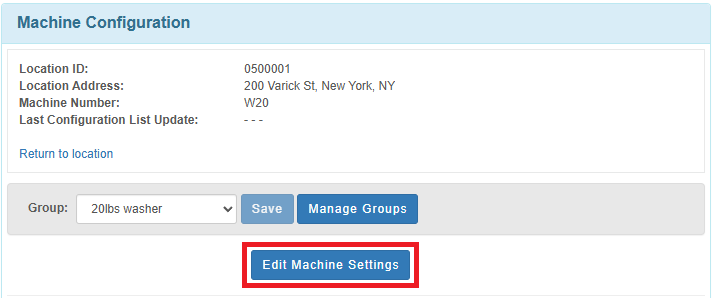
This will bring up a pop up window showing the current settings this reader is using.
You can then adjust the price settings for this individual reader,
and click the Update Settings button to have the system push the new price settings to the reader:
If you only need to adjust the price settings of a single reader, it's usually faster to make the change at the individual reader, rather than using the bulk pricing menu to update it's price settings.
Troubleshooting
Below are common issues you may encounter when attempting price changes on your machines/readers:
Issue | Explanation and Resolution |
| Price being displayed on the Card Reader is NOT the same as the price being displayed on the Machine's Display | Explanation: If you encounter this issue, it's likely you have card readers that use Pulse communication and NOT serial communication. Pulse communication means that the card reader is simply emulating a coin being inserted into the machine, whenever a card is used to make payment. Pulse communication readers do NOT communicate with the machine's control board directly, so the reader has no way of updating the price being displayed on the machine's display. If you have Pulse communication card readers, when you adjust the price on the Laundro Portal, this will only affects the price being displayed on the card reader itself (note: whatever price the card reader displays, is the price that customers actually pay when tapping their card on that reader) Resolution: You will either need to adjust the price being displayed on the machine, or if your machine allows for this, you can simply turn off the display on the machine, so that the card reader is the only thing displaying the vend price. Note: IF adjusting the price displayed on the machine, you also NEED to adjust the machines Coin/Pulse value to match. Pulse readers are emulating a single coin being inserted into the machine to make the payment, so if you change the price setting on the machine itself, you also NEED to change the Coin Value setting on that machine to match the new Vend price. The reader ONLY sends 1 pulse (1 "coin") so you want to ensure that the value of that "coin" is enough to pay for the full machine start |
After changing the prices of my machines, the Card Readers no longer start the machine, and the Machine's display shows a balance remaining, that needs to be paid, in order to start the machine | Explanation: If this issue started happening right after changing prices, it is likely that you have Pulse communication card readers, and when you changed the price of the machine, you did not also adjust the machines Coin value setting to match Resolution: You need to adjust the machine's Coin Value setting so it matches the new vend price of the machine. When the card reader makes a payment, it only sends 1 single pulse to the machine to get it to start. The machine sees this "pulse" as a coin being inserted, so you want to make sure the machine knows that the "coin" from the card reader is equal to the full vend price of that machine |
The Bulk Pricing menu does not show any price settings for me to change | Explanation: If you have one of the following machines: - Dexter C-series Dryers - Speed-Queen Quantum Touch washers and dryers - Maytag Gen2 control machines - LG machines these machines do not allow for price changes from the Laundro Portal. Once you change the price settings on the machine itself, the machine will update the card reader with the new price. In most cases, if you have a machine like the above machines, you'll see a warning message in the Bulk Pricing page saying these readers have no price settings to configure: For all other machines, first check to ensure you're not seeing any error message, in the bulk pricing menu, about the specific card reader you're trying to price. Examples of errors message you may see include: or Resolution: In most cases, simply power cycling the machine (unplugging machine from power, and plugging power back in) will trigger the card reader to reboot, and this will clear most errors you'll see in the Bulk Pricing page. If you have an error message related to Group Membership, navigate to the Manage Groups menu, as you may have a reader grouped with other readers that use different reader settings. Once you've corrected any reader group issues, you should then be able to use the Bulk Pricing page to price the readers. |